A Rainy-Day Walk for Reading a City Block
A rainy-day walk for reading a city block reveals how doorways, awnings and sheltered edges shape everyday street use without entering private spaces.
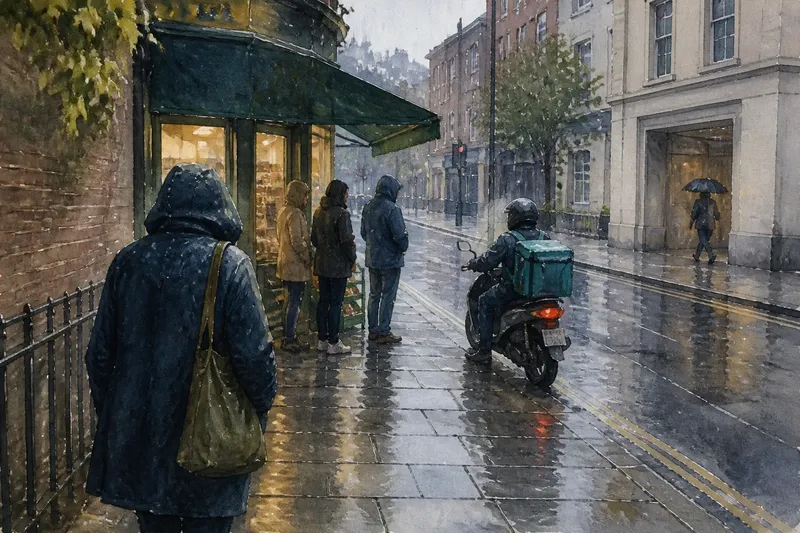
Rain ticks against the hood of your coat as you reach a corner shop, where three people are waiting beneath its narrow awning. A delivery rider pauses beside the kerb; across the road, someone hurries through a recessed doorway and disappears from view. A rainy-day walk for reading a city block makes these small adjustments easier to see: weather gives people reasons to choose one edge, entrance or route over another.
The aim is not to guess what happens inside a building or to treat a passing moment as proof of a lasting pattern. It is to notice what can be seen from public space: where rain falls, where shelter begins, how people approach thresholds, and which parts of the pavement remain in use. Follow one block slowly, record changes as you go, and leave private entrances and interiors alone.
What can rain reveal about a city block?
Dry weather can make a pavement look like one continuous strip. Rain draws useful distinctions across it. A canopy interrupts the downpour; a set-back entrance offers a brief pause; a tree may shelter one person while leaving another exposed. These are not just architectural details. They shape where people can stop, wait, pass or avoid getting wet.
Look for the point where one condition changes into another. Water may run from a roof edge onto the pavement, collect along a sloping kerb, or fall through a gap between two awnings. A covered arcade may feel like a route in its own right, while a bare stretch between buildings encourages brisk passage. Notice the boundary, not only the feature: shelter is often uneven, and a dry patch can end abruptly.
Keep observations modest. A person standing under an awning might be waiting for a bus, checking a phone, sheltering from a shower or preparing to enter the shop. You can describe the visible action and its setting; you cannot reliably infer the person’s reason. That restraint makes the walk more accurate, and it keeps other people from becoming props in a story about the street.
How should you choose the route and pace?
Choose a public block with a clear beginning and end, such as one corner to the next intersection. A high street, a mixed residential-and-shopfront street or a block beside a station can all work. Pick a route with pavements and public access, not one that requires crossing a private courtyard or entering a lobby. If the weather or footing feels unsafe, shorten the walk or stay beneath established public cover.
Before setting off, note the time, the general weather and the direction you plan to walk. A pocket notebook and pencil are enough; a phone’s notes app or camera can help if you prefer, but take pictures of buildings and public details rather than identifiable people. Keep the device away when you need your attention for traffic, steps or other hazards.
Walk once without trying to interpret everything. On the return, pause at a few public vantage points and look more carefully. This gives you a basic sense of the block before you start sorting observations into themes. It also helps separate what you saw on the first pass from what you noticed after slowing down.
Use the same direction for each pass if you want to compare locations. You might mark a simple line in your notebook: corner, shopfront, covered passage, blank wall, bus stop, next junction. The point is not to draw an accurate map. It is to place each observation somewhere specific, so “there is a dry waiting spot” does not float free of the street that created it.
What should you look for at entrances and edges?
Start with thresholds: the visible meeting points between pavement and building. From outside, you can note a door set flush with the frontage, a recessed entrance, a step, a ramp, a gate, a bell panel or a canopy. Do not touch fixtures, peer through windows or try a door. The question is how the entrance meets the public route, not what lies beyond it.
Watch how rain changes the approach. Does a person cross a wet strip before reaching the door? Is there a shallow recess where someone can pause without blocking the pavement? Does a canopy cover the entrance itself, or only a display window? An entrance may be easy to spot yet awkward to reach in bad weather. Record the visible arrangement rather than judging access from appearance alone.
Then follow the sheltered edges. A shop awning may draw a queue close to the wall, while a building overhang leaves enough room for people to pass behind those waiting. A covered arcade can connect several frontages, but a gap between roofs may expose anyone moving through it. Trees, bus shelters and projecting upper floors also create local shelter, though none necessarily protects the whole pavement.
Pay attention to what shelter does to movement. People may slow at a doorway, gather beside a dry shop window, or move in a line under a continuous canopy. Others may step out into the rain to pass a group. Describe the pattern you can see and its location. A short observation is more useful than a broad claim about who belongs on the street or how the neighbourhood behaves.
How does wet weather change the street’s use?
Look for changes in pace and purpose. Some people move directly through the rain; others pause under a bus shelter, awning or tree. A delivery may be unloaded at the nearest covered edge, then carried across an exposed patch. A queue might bend around a doorway to avoid the flow of water. These moments show how public space is adjusted in practice, even when the street’s formal layout remains unchanged.
Notice the less obvious signs, too. A wet strip may be avoided, leaving a narrow dry line along a wall. A broad pavement may feel crowded when everyone shares one sheltered section. A bench can remain technically available but become less inviting when its seat is soaked. If you see no one using a feature, record that absence cautiously: a quiet moment does not tell you what happens at another hour or in different weather.
Sound and surface can help locate these shifts. Rain may drum on a metal canopy and soften beneath a deep arcade. Water running toward a drain can make one part of the kerb noticeably busier or less comfortable to stand near. You do not need to identify the engineering behind it. Note what is observable: where water travels, where it pools, and how people route around it.
Keep the block’s different users in view without assigning them fixed identities. A person with an umbrella needs room to pass someone carrying bags; a wheelchair user may have to avoid a puddle or a narrow pinch point; a child may pause at a covered shopfront. These are practical possibilities to consider, not assumptions about individuals. If access is unclear from the pavement, say so rather than filling the gap with a guess.
What questions help you read the block?
How can I tell where a public route ends and a private entrance begins?
Use visible cues such as a gate, sign, marked boundary or doorway leading into a controlled building, and remain on the public pavement. You can describe how the entrance meets the street without crossing it or looking inside.
What should I record if the rain stops during the walk?
Note when the weather changes and which surfaces remain wet or sheltered. Puddles, dripping canopies and damp pavement can still show how water has travelled, but describe them as conditions at that moment rather than a permanent feature.
Can one rainy walk tell me how a street works?
It can offer a close account of one block in one set of conditions, not a full picture of the street’s daily life. Treat your notes as a starting point and keep the time and weather attached to what you observed.
Should I photograph people using the shelter?
For a personal street-reading record, focus on the awning, doorway, pavement or other public feature instead of identifying passers-by. A written note can capture a movement pattern without intruding on someone’s privacy.
What happens on one invented walk?
Say you begin at a fictional corner shop on a mixed-use block during steady rain. The first awning covers the doorway and a section of pavement but leaves the bus stop exposed. You note three people waiting under the shopfront and one person standing at the shelter farther along. You do not decide why the first group chose the shop; you record their position, the roof edge and the uncovered gap between the two waiting places.
On the return pass, you see a delivery worker carrying a box from a van across that gap. The worker pauses briefly under a tree, then continues to the shop entrance. You write down the sequence as a visible movement: van, exposed pavement, tree cover, recessed doorway. You do not follow the worker or look inside. The block’s public edges provide enough detail for the observation.
At the next doorway, water falls from a short canopy onto the pavement just beside the entrance. A passer-by steps around the wet patch; another walks through it. You record the splash zone and the two different paths. That is more precise than calling the entrance inconvenient, because it distinguishes what you saw from the conclusion you might draw later.
By the time you reach the next junction, your notes show a loose chain of sheltered and exposed places: shop awning, wet gap, tree, recessed entrance, uncovered bus stop. The expected result of this invented walk is not a verdict on the block. It is a small, grounded account of how rain made certain edges useful, left other places exposed and changed the routes people took in view of the public street.
How can you turn notes into a fair reading?
When you finish, sort notes into three kinds: visible features, observed actions and questions you cannot answer from the pavement. “The awning covers the door” is a feature. “Two people wait beneath it” is an action. “Are they waiting for the shop to open?” is an unanswered question. Keeping those categories separate prevents a momentary scene from becoming an overconfident story about the whole neighbourhood.
Look for relationships rather than isolated objects. A doorway matters here because of its position beside the dry route; a bus shelter matters because the nearest shop canopy offers another place to wait. Ask whether shelter connects useful destinations, breaks off at a busy crossing or concentrates people in a narrow space. The block reads as a sequence of choices, not a collection of architectural labels.
Time and weather belong in the record. A drizzle, a sharp shower and the minutes after rain stops can create different street conditions. A school run, a delivery period or a quiet afternoon may also change who uses a sheltered edge. If you revisit, keep the route and observation points similar, then note what differs. Avoid treating one visit as a rule for every day.
Finally, let uncertainty remain visible. A recess might be intended as an entrance, a sheltered pause or simply the shape of the frontage; from outside, you may not know. That does not make the walk pointless. The most useful rainy-day walk for reading a city block shows where public movement meets shelter, where rain interrupts it, and which questions deserve a later visit—without claiming access to private life.