From Market Ground to Meeting Place: The Changing Idea of the City Square
Explore how the city square changed from market ground to civic meeting place, and learn to read the stalls, edges and open space that reveal its roles.
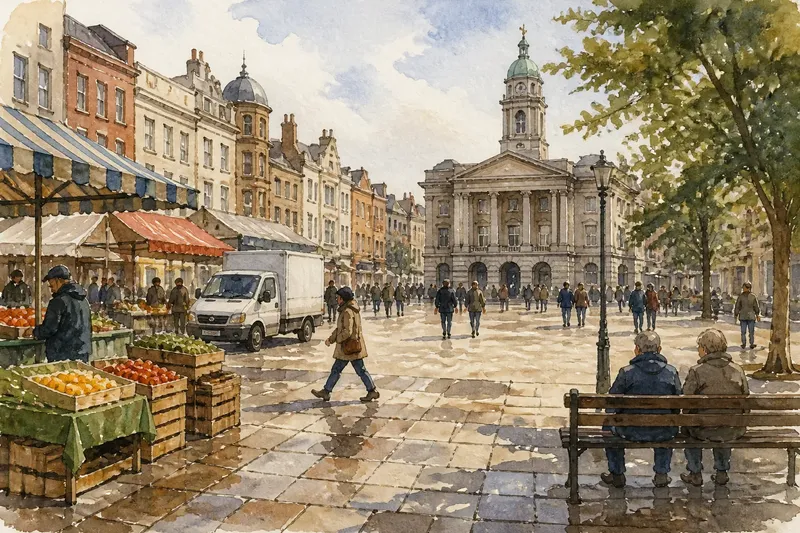
On a weekday morning, a delivery van noses past a row of market stalls while a passer-by cuts across the open paving. By evening, the stalls may be gone and the same patch of ground may hold a rally, a concert or nothing but the sound of footsteps. A city square is not simply an empty space between buildings: it is shared ground whose meaning shifts with the people, rules and routines gathered there.
What makes a city square different from an ordinary open space?
A city square is an open area closely bound to the streets and buildings around it, and used as a recognisable place within the city. Its edges help give it a shape; its entrances connect it to movement beyond; and its activities make it more than a gap in the built fabric. A square may be paved or planted, formal or irregular, busy or quiet.
The distinction is partly practical. A park usually invites people into a landscape of paths and planted ground, while a square often gives more prominence to circulation, trade, gatherings and the fronts of surrounding buildings. That is a tendency, not a rule. A civic square can contain trees and lawns; a market square can have benches and play space.
Look at how a place is approached and occupied. Do several streets feed into it? Are there entrances to shops, a town hall, a station or a place of worship along its edge? Can people pause without blocking the main route? These details hint at whether the space works as a destination, a crossing point or both.
Why did markets gather in the square?
Open ground offered room for people to meet sellers, unload goods and browse without weaving through narrow streets. Its position at the junction of routes could draw in customers from different parts of a town. Nearby buildings might provide civic offices, places of worship or shelter, tying exchange to other shared activities.
The square also made trade visible. A buyer could compare wares at neighbouring stalls, while a seller could benefit from the flow of passers-by. The market’s temporary arrangement—tables, carts, awnings or stalls—could change the feel of a place from day to day without changing its permanent buildings.
Markets were not always open to everyone on equal terms, nor did every square serve the same mix of people. Local rules could shape who might trade, what could be sold and when the ground was available. A square’s commercial role therefore sat alongside questions of authority and access: somebody decided how the shared surface could be used.
How did commerce and civic life share the same ground?
Trade and public business were often neighbours rather than separate chapters. A square could bring customers to shops while also offering a place for announcements, ceremonies, assemblies or public displays. The same open ground could support ordinary errands and occasions that made a community visible to itself.
That overlap is legible in the edges. Shopfronts and arcades suggest exchange; a town hall, courthouse or civic building suggests administration and public authority. A church or other prominent institution may add another layer. These clues do not tell the whole story, but they show how different uses could face the same space.
Consider a covered market beside a municipal building. The roof may protect sellers and shoppers, while the uncovered paving remains available for a gathering or a clear route across the square. In that arrangement, the boundary between commercial and civic space is not a line on a plan. It is negotiated through schedules, access and the way people move around one another.
What changed when markets moved indoors?
When buying and selling shifted into purpose-built market halls, covered centres or shops, the square could lose some of its everyday commercial traffic. The change did not automatically make it a civic meeting place. It might instead become a route, a forecourt, a ceremonial setting or a place people passed through on their way elsewhere.
Buildings made for trade could also leave a lasting imprint after their original use faded. A former market hall might become a cultural venue or public facility, keeping the memory of commerce in its doors, roof span or position on the square. A cleared market site might reveal a different story: new paving, planted areas or monuments can shift attention towards leisure, display or civic identity.
Imagine a town moving its produce stalls into a nearby hall. The square’s central rows of trading tables disappear, but shopfronts remain around its perimeter and a bus stop continues to bring people past. If the council adds seating and keeps a clear area for occasional events, the expected visible result is a space used for both brief rests and scheduled gatherings, rather than a daily market. The example is invented, but it shows how a change in one activity can alter the balance of a place without erasing its other roles.
Who decides what a square is for?
Its uses are shaped by public authorities, property owners, traders, organisers and the people who use it day to day. Decisions about licences, maintenance, vehicle access, seating and event permissions can make some activities easier and others difficult. Even a small practical choice—whether tables can stay after trading hours, for instance—can affect who lingers.
Ownership matters, too. A space may look public while being managed by a private institution, or it may be publicly owned but governed by rules that limit certain gatherings. Signs, barriers, guards and opening hours offer clues about how access is managed. For the exact rules of a particular place, check its posted terms or the responsible local authority.
There is no single ideal balance. A lively market can make a square feel useful and sociable, yet leave little room for quiet sitting. A clear, uncluttered surface can support assemblies and movement, yet feel exposed or empty on an ordinary day. The design question is not just what fits, but whose needs are being considered and at what times.
How can you read a square’s changing role today?
Start with a simple walk across the space, then pause at its edge. Notice the paving, entrances and traces of temporary activity. Look for what is fixed, what can be moved and what appears only at certain times. A place can reveal more through its daily arrangements than through a grand name on a sign.
- Read the ground. Look for stall fixings, service covers, worn paths, painted markings or changes in paving. These may suggest where trading, events or regular movement take place.
- Study the edges. Note which doors open directly onto the square and whether they belong to shops, civic buildings, cafés or homes. Active doorways can bring different rhythms into the same space.
- Watch the crossings. See whether people cut through the middle, follow a defined route or avoid a busy edge. A square may function as a shortcut even when its design invites people to stop.
- Check the furniture. Benches, movable chairs, bollards and temporary barriers each shape how people occupy the ground. Notice whether seating faces other people, a performance area or the street.
- Compare different times. A market morning, a lunchtime pause and an evening event can reveal contrasting uses. Make another visit if you can; one quiet moment cannot explain the whole pattern.
These observations help distinguish the square’s declared purpose from its lived use. A plaque might describe civic importance, while the worn route across the paving points to daily passage. Neither cancels the other. Together, they show how the city square holds memory and routine at once.
Why do some squares feel welcoming while others feel exposed?
Welcome depends on more than open space. Shelter, shade, comfortable places to sit, clear routes and nearby doors can make it easier to stay. A broad, bare surface may work well for a large gathering, but feel uncomfortable for a short break if there is nowhere to sit or escape wind and sun.
Edges are especially important. A café terrace or an open ground-floor room can lend activity to the square, while a blank wall may leave people feeling watched by no one and connected to nothing. Yet a continuous edge is not automatically hospitable: a tightly controlled terrace can occupy space that might otherwise be available to everyone.
Consider where a person can pause without buying anything, obstructing a route or joining a formal event. That question brings the idea of shared ground into focus. A square’s civic character is not measured only by ceremonies or monuments; it is also expressed in whether an ordinary visitor can use the place without needing a special reason.
What should you look for in a city square’s story?
Follow the changes in use rather than searching for one original purpose. The market may have moved, but its route connections, building edges or open central surface can still shape how people gather. Later additions—trees, memorials, seating, bus stops or event equipment—may introduce new meanings without fully replacing older ones.
Ask who can occupy the space, what activities are encouraged, and what gets moved aside when an event arrives. Then compare those answers with the physical clues. A city square tells its story through arrangements that can be temporary as well as permanent: a line of stalls, a clear route, a set of steps or a row of chairs.
To read a city square well, look for the changing terms of sharing. The most revealing detail may be a stall that appears each week, a bench placed at the sunny edge or a patch of paving kept clear for public gatherings. Each shows that open ground is not merely left over between buildings; people continually decide what it can hold.