Brick, Stone or Render: What a Facade Lets You Notice
Brick, stone or render can reveal how a facade handles texture, joints and light, helping you read a building’s visible character without guessing its age.
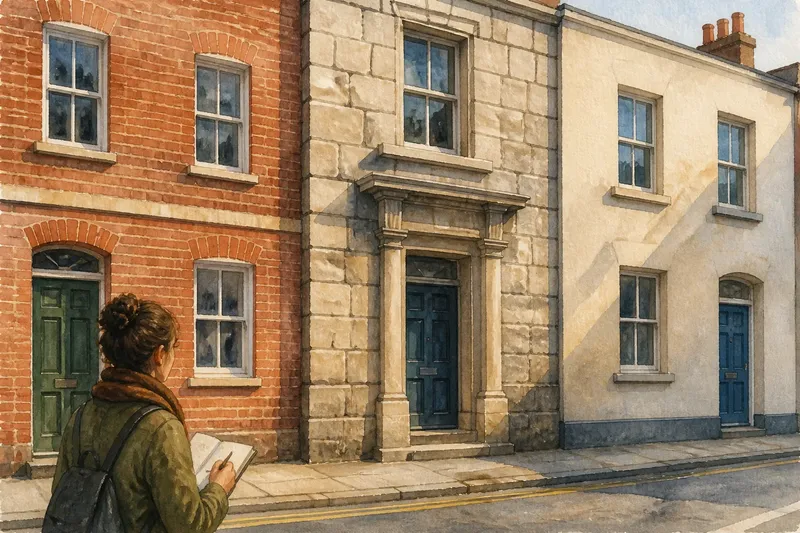
At a street corner, a brick wall catches the low sun in a scatter of red edges, while a pale rendered facade beside it holds the light in a broad, quiet plane. Brick, stone or render: a facade lets you notice different things before you have any reason to guess how a building began. Read the finish as a visible surface, not as a shortcut to its age, original purpose or biography.
What can a facade surface tell you?
An exterior finish shapes the way a building meets the street. Look for texture, colour, joints, changes in plane and the way light shifts across the wall. These are clues you can see directly. They can help explain why one frontage feels finely patterned, another weighty and another almost continuous.
Keep the distinction clear: a visible finish is not always the material beneath it. A wall that looks like stone may use a thin facing; brickwork may be painted; render may cover masonry of several kinds. A doorway, exposed edge or repair can offer more clues, but appearance alone cannot settle what lies behind the surface.
What does brick make visible?
Brick presents a wall through repeated units and the lines between them. Running bonds, projecting courses, recessed panels and changes in brick colour can give a facade a strong rhythm. At close range, mortar joints draw a fine grid; from farther away, they may merge into a warmer, more even field.
Notice how openings meet that pattern. A row of windows may interrupt the courses cleanly, while a lintel or brick arch makes the change around each opening more pronounced. At a corner, look for a shift in bond or a different edge treatment. Such details describe the visible construction and composition, but they do not by themselves establish when the wall was built.
Brick often suits a reader interested in repetition and small variations. It can make a long street frontage feel ordered without making every section identical. If the bricks are painted or heavily weathered, the joint pattern may still be legible, though colour and texture become less dependable clues to the original finish.
How does stone change the reading?
Stone facades often draw attention to blocks, edges and the weight of the wall. The surface may be smooth and regular, or rough enough to cast sharp little shadows. Look at the joints: narrow, even lines can make a frontage read as a continuous plane, while larger blocks make the individual pieces more apparent.
Stone can also frame openings and corners with a noticeable change in texture or depth. A projecting surround catches light differently from the wall around it; a carved or tooled surface invites a closer look. These features are useful for understanding emphasis and finish. They are not proof that the whole building is made from the same stone, or that its visible arrangement tells a complete construction story.
Choose stone as your main visual cue when you want to follow mass, edge and shadow. It is particularly legible at entrances and around windows, where the contrast between a flat wall and a shaped surround can make the facade’s composition easier to see.
Why can render feel more continuous?
Render covers the wall in a coating that can soften or hide the pattern beneath. Its visual character comes through colour, surface texture, corners and the way the finish meets window frames or neighbouring materials. A smooth coat may make the facade read as one broad plane; a rough or patterned finish breaks that plane into smaller patches of light and shade.
Look for changes in tone and texture across a rendered frontage. A repaired area may sit slightly differently from the surrounding surface, while a boundary at a shopfront or upper floor may mark a change in finish. These are observations about the present appearance, not a reliable account of what the wall looked like before.
Render suits readers who want to notice colour fields, broad surfaces and transitions between parts of a building. It can also make comparison harder: a coating may conceal joints or underlying material, so the facade offers fewer direct clues about its construction than exposed brick or stone.
Which finish suits the question you are asking?
For a quick comparison, ask what you want to read from the street rather than which material seems most impressive. Brick makes repetition and joint patterns easy to follow. Stone puts attention on blocks, edges and relief. Render foregrounds colour, texture and the overall shape of the wall.
Imagine you are sketching two neighbouring frontages in a notebook. The first has exposed brick with a clear bond; the second has a pale rendered surface with no visible joints. If your aim is to map repeated details, the brick offers a stronger guide. If you want to compare how window openings sit within broad wall planes, the render may be easier to read. The choice follows the question, not a claim about either building’s past.
For a useful street-level comparison, note:
- Texture: Is the surface smooth, rough, ribbed or visibly made of separate units?
- Joints: Can you follow mortar lines, block edges or breaks in a coating?
- Light: Do projections create strong shadows, or does the wall read as a flatter field?
- Openings: Does the finish continue around windows and doors, or change at their edges?
- Colour: Is the tone consistent, varied across units or interrupted by patches?
- Transitions: Where does the finish meet a plinth, entrance, shopfront or adjoining facade?
Use the answers to choose what to draw or describe. Follow joints when the wall’s pattern is the point; trace outlines and shadows when depth matters; compare broad colour areas when the surface is continuous. If a finish is painted, patched or partly covered, record that plainly instead of treating the concealed material as obvious.
What should you avoid inferring from a finish?
Brick, stone and render can all be used in different ways, altered over time or combined on one frontage. A rendered upper storey above a brick ground floor, for instance, is first of all a visible change in finish. It might prompt a closer look at the boundary, but it does not alone tell you why the materials differ.
Likewise, a polished stone entrance does not establish the character of every room inside, and a plain rendered wall does not mean the building has no detail. Keep description and interpretation separate: “deep joints around the windows” is something you can point to; a claim about the building’s original status needs more than a surface impression.
How can you read a facade more closely?
Can brickwork reveal the wall beneath?
Exposed brick gives a clear view of units and joints, but it does not show every layer behind them. Describe the visible bond and finish rather than assuming the whole wall has the same construction.
Does stone always mean a solid stone building?
No. Stone may appear as a facing or as part of a mixed facade, and a street view may not reveal the wall’s full make-up. You can still read block size, surface treatment and the way stone frames openings.
Can render hide useful details?
It can cover joints and changes in the underlying wall, leaving colour, texture and edges as the clearest visible features. Treat a smooth surface as evidence of a continuous finish, not proof that the material beneath is uniform.
Which finish is easiest to compare while walking?
That depends on the detail you want to follow: brick is helpful for repeated courses, stone for block edges and relief, and render for broad planes and colour. Pick one feature, then compare how it changes from one frontage to the next.
On your next walk, let the finish set the scale of your attention. Trace a mortar line, follow a stone edge or notice where a rendered plane meets a window frame. Brick, stone or render can make a facade easier to read when you use it to describe what is actually there, leaving the building’s hidden history open rather than guessed.